What Is High-Altitude Platform Stations (Haps) Explained
1. HAPS occupies a sweet spot between Earth and Space
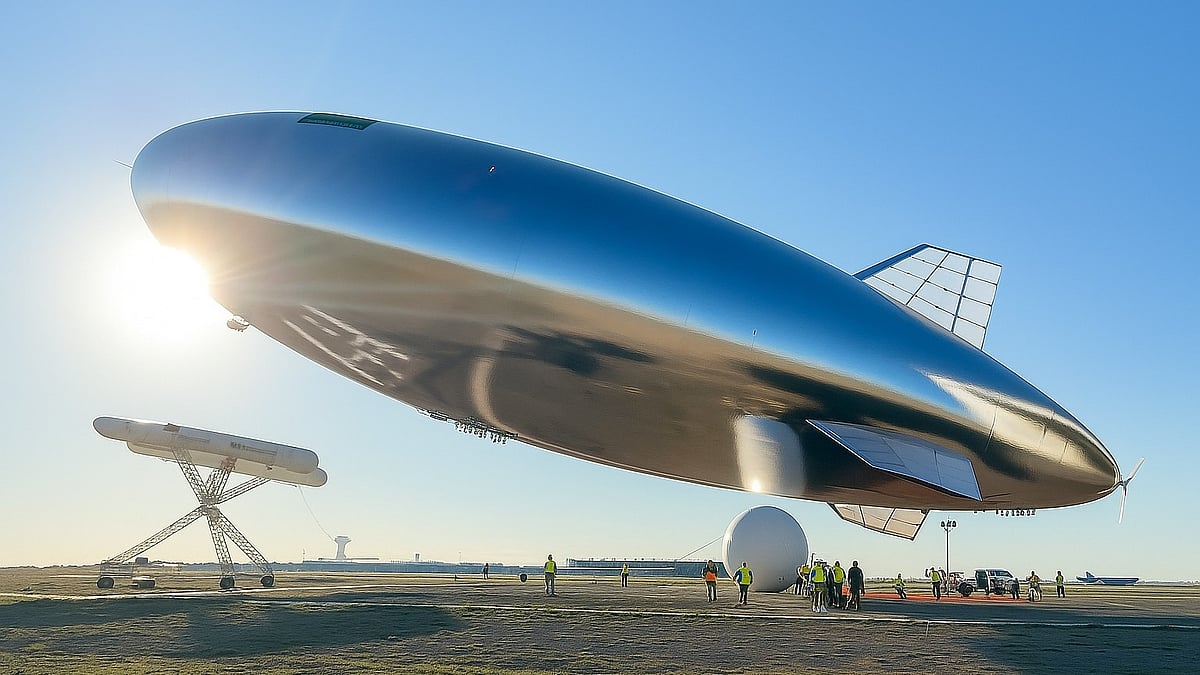
It is time to forget the binary distinction of ground towers and orbiting satellites. High-altitude platform stations are operating in the stratosphere. They are typically between 18 and 22 km above sea level. a layer of atmosphere with such a calm and predictable environment that an aircraft built to perfection can remain in its place with astonishing precision. This altitude is large enough to provide massive geographic footprints with a single aircraft, yet still close enough Earth that latency in signal transmission stays at a minimum and the equipment doesn’t need to face the severe radiation-laden atmosphere of orbital space. It’s truly an underexplored portion of sky, and the aerospace world is just commencing to seriously explore it.
2. The Stratosphere is more tranquil than You’d Expect
One of most contradictory aspects of stratospheric flight the stability of the environment relative to the turbulent troposphere below. At the stratospheric level, the winds are relatively smooth and consistent this is extremely important for station keeping, which is the capacity of the HAPS vehicle to stay in it’s position within the target area. When it comes to earth observation or telecom missions, drifting even one or two kilometres from the position could affect the quality of coverage. Platforms designed for absolute station-keeping, such as those developed by Sceye Inc, treat this as a core design principle instead of as an additional consideration.
3. HAPS Stands for High-Altitude Platform Station
The acronym in itself is worth delving into. High-altitude platform stations are specified in ITU (International Telecommunication Union) frameworks as a location on an object that is located at an altitude of between 20 and 50 km in a specified, nominal fix position with respect to Earth. The “station” feature is deliberate they aren’t research balloons floating across continents. They’re observation and communications infrastructures that are located on stations carrying out persistent missions. Think of them less like aircraft and more like small, reusable satellites. They also have the ability of returning, being serviced and repositioned.
4. There are a variety of vehicle types Under the HAPS Umbrella
It’s not the case that all HAPS vehicles look alike. The range includes solar-powered fixedwing aircrafts, airships lighter than air, as well as tethered balloon systems. Each one has its own set of trade-offs with respect to payload capacity, endurance, and cost. Airships are one example. They have the capacity to carry heavier loads for longer periods since buoyancy does much of the lifting, freeing up solar energy for propulsion, station keeping also known as the onboard. Sceye’s method employs a lighter than air model specifically designed for airships to maximize payload capacity as well as mission endurance and mission endurance. It is a thoughtful architectural choice that separates it from fixed-wing competitors chasing altitude records with little or no burden.
5. Power Is the Central Engineering Challenge
Inflating a platform into the stratosphere for months or weeks without refueling means figuring out an energy problem with only a small margin of error. Solar cells can store energy in daylight hours, however the platform must survive the evening without power storage. This is when battery energy density becomes vital. Innovations in lithium sulfur battery chemistry and energy density close to 425 Wh/kg enable stratospheric endurance efforts to become increasingly feasible. Coupled with an increase in solar cell performance, the goal is a closed, dependable power loop with the ability to generate and store enough energy every day that it is able to run full-time operations for years.
6. The Footprint Coverage Is Huge Compared to Ground Infrastructure
A single high-altitude tower station at 20 km in altitude can have a footprint that is hundreds of kilometres. A typical mobile tower only covers only a few kilometers at most. This inequity renders HAPS an ideal choice for connecting in remote areas and regions that aren’t well-served, or where the construction of terrestrial infrastructure is feasible. A single spacecraft could perform what normally requires hundreds or dozens of ground assets — making HAPS one of the most credible proposed solutions to our ever-widening connectivity gap.
7. HAPS Can Carry Multiple Payload Different types simultaneously
Unlike satellites, which are usually locked into a defined mission at the point of beginning, stratospheric platforms have the ability to transport multiple payloads at once and altered between deployments. A single vehicle might carry a telecommunications antenna for broadband service, or sensors for greenhouse gas monitoring and wildfire detection. It could also be used for surveillance of oil pollution. This multi-mission versatility is just one of the strongest economic arguments in favor of HAPS investment. It is the same infrastructure serving connectivity and temperature monitoring simultaneously, rather than needing separate resources for each of the functions.
8. The technology can be used to enable Direct-to Cell and 5G Backhaul Applications
From a telecommunications perspective the thing that will make HAPS unique is its compatibility with the existing ecosystems of devices. Direct-tocell methods allow standard smartphones connectivity without the need for additional hardware, while HAPS functions as a HIBS (High-Altitude IMT Base Station), which is essentially a mobile tower in the air. It also can serve as 5G backhaul, connecting remote earth infrastructure to other networks. Beamforming technology allows an application to steer signals precisely to the locations where there is demand rather than broadcasting randomly thus increasing the spectral efficiency substantially.
9. The Stratosphere Is Now Attracting Serious Investment
The research area just a decade ago has drawn significant investment from major telecoms companies. SoftBank’s partnership with Sceye on a planned nationwide HAPS connectivity network for Japan with a focus on pre-commercial services in 2026, represents one of the most significant commercial commitments to connectivity in the stratosphere to the present. This signals a shift from HAPS being considered to be an experimental technology becoming a deployable an infrastructure that can generate revenue- an endorsement that is important for the broader market.
10. Sceye Represents a New Model for Non-Terrestrial Infrastructure
Created by Mikkel Vestergaard and based out of New Mexico, Sceye has made itself known as a significant long-term player in this truly frontier-level aerospace. Sceye’s emphasis on combining endurance, payload capacity, and multi-mission capabilities reflect the idea that stratospheric platforms are likely to become a constant layer of infrastructure across the globe which is not a novelty or gap-filler that is merely a third layer that will sit between the terrestrial network as well as orbital satellites. For connectivity, climate observation, or disaster response, high-altitude platform stations are starting to appear less like a fanciful idea and more like a natural aspect of how humanity watches and interacts with the planet. Follow the top solar cell efficiency advancements for haps or stratospheric aircraft for website examples including japan nation-wide network of softbank corp, what is a haps, high-altitude platform stations definition and characteristics, softbank sceye partnership haps, softbank investment sceye, sceye haps payload capacity, Monitor Oil Pollution, Station keeping, natural resource management, Sceye Wireless connectivity and more.
Sceye’s Solar-Powered Airships Will Bring 5g Technology To Remote Regions
1. The Connectivity Gap Is a Infrastructure Economics Issue First
Around 2.6 billion people have no any internet access at all, and the reason for this is usually due to the absence of suitable technology. It’s an absence of economic justification for deploying that technology in areas where density is too low, terrain is too difficult, or political stability isn’t stable enough to warrant an average return on infrastructure investments. Building mobile towers through mountainous archipelagos, deserted interior regions, or sparsely populated island chains costs real money against revenue projections that don’t justify it. This is the reason why the gap in connectivity has remained regardless of years of effort and genuine goodwill — the problem isn’t in the awareness or intentions, it’s the unit economics of terrestrial rollout in places which aren’t compatible with the standard infrastructure blueprint.
2. Solar-powered Airships Transform the Deployment Economy
A stratospheric aircraft that operates as an antenna for cell phones at the top of the sky alters prices of wireless connectivity in ways that make a difference on a practical level. One platform at 20 kilometers above the ground covers a footprint below ground that will require numerous terrestrial towers that can be replicated, without the civil engineering or land acquisition, the power infrastructure, or ongoing maintenance that ground-based deployment demands. The solar-powered part of the system removes fuel logistics entirely — the platform generates its own electricity from sunlight, keeps it in high-density storage for overnight operation, and will continue to function without supply chains reaching out into remote terrain. In the regions where the primary barrier to connectivity is primarily the expense and complexity of the physical infrastructure that is the real issue, this is a new approach.
3. The 5G Compatibility Test Is More Important Than It Sounds
It is true that delivering broadband from the stratosphere is only practical commercially if it connects to devices people actually own. Early satellite internet systems required advanced terminals that were expensive weighty and bulky. They were also not suitable for widespread use. The evolution of HIBS technology High-Altitude Inductive Base Station standards — makes stratospheric devices compatible with the standard 4G and 5-G protocols which smartphones of today use. A Sceye airship operating as a telecommunications antenna can, in principle support mobile devices from a standard smartphone without any additional hardware on the consumer’s side. Its compatibility with current operating systems is the key difference between a connectivity solution that reaches all users in a range of coverage and one that is restricted to those that can be able to pay for special equipment.
4. Beamforming Converts a Wide Footprint into a streamlined, targeted coverage
The raw coverage footprint of a stratospheric structure is vast but coverage in raw form and the capacity that is useful are two different things. Broadcasting signals uniformly across a large area of 300 km wastes most of the available spectrum in areas that are not inhabited, open waters, and regions in which there aren’t any active users. Beamforming technology enables the stratospheric telecom antenna target energy emitted by the signal areas of demand that actually exist -an area of fishing on one shoreline as well as an agricultural area in another and a town suffering from a catastrophe in a third. This smart signal management greatly increases the spectral efficacy, which directly impacts the capacity that is available to users rather than the theoretical maximum area of coverage the platform could provide for broadcasting without discrimination.
5G backhaul applications profit from the same method -direct high-capacity links to nodes in the ground infrastructure that require them instead of spraying capacity over empty areas.
5. Sceye’s Airship design maximizes the payload The Airship is available to Telecoms Hardware
The telecoms-related payload that is onboard the stratospheric platform — antenna arrays and signal processing units beamforming equipment power management systemsare of real weight and volume. A vehicle that is spending the bulk of its energy and structural budget simply surviving in air, isn’t able to provide meaningful telecoms equipment. Sceye’s lighter-than air design tackles this directly. Buoyancy transports the vehicle with no constant energy consumption for lifting, meaning that the available capacity and power can handle a telecoms signal large enough to supply commercially-useful capacity rather than a sporadic signal covering a large area. Airships aren’t just an accessory to the purpose of connectivityit’s what makes carrying a high-quality telecoms equipment together with other mission equipment viable.
6. The Diurnal Cycle governs whether the Service is Intermittent or Continuous.
A connectivity solution that operates during daylight and goes dark at night is not an actual connectivity service- it’s a demonstration. In order for Sceye’s airships powered by solar to offer the type of uninterrupted protection that isolated communities, emergencies personnel and commercial operators rely on, the system must overcome the problem of energy during the night effectively and consistently. The diurnal period — that is, generating sufficient solar power during daylight hours to power all systems and charge batteries in sufficient quantities to be fully operational until next sunrise — is the main engineering restriction. The advancements in lithium sulfur battery energy density, which is now approaching 425 Wh/kg, as well as improving solar cell efficiency on stratospheric aircraft are what make this loop complete. Without these perseverance and continuity, they are more theoretical than practical.
7. Remote Connectivity Causes Additional Social and Economic Impacts
The reason for connecting remote regions isn’t only a matter of humanitarians in the sense of abstract. Connectivity facilitates telemedicine, which decreases the costs of healthcare delivery in areas with no hospitals nearby. It allows distance learning that doesn’t need to build schools in every town. It provides access to financial services that can replace cash-dependent economies by the efficacy through digital commerce. It enables early warning systems of natural disasters to reach communities most affected by them. All of these impacts increase in the course of time as communities grow digital literacy and local economy adapt to reliable connectivity. The stratospheric internet rollout starting to offer coverage to remote areas isn’t simply delivering a luxuries the rollout is delivering infrastructure with downstream impacts across health, education, security as well as economic participation.
8. Japan’s HAPS Network shows what National-Scale Deployment Will Look Like
The SoftBank association with Sceye which aims to introduce pre-commercial HAPS applications in Japan 2026 is noteworthy partly because of its scale. A nationwide network implies multiple platforms that provide overlapping, continuous coverage across a region whose geography is comprised of thousands of islands, mountains interior, and long coastlinesthat creates the exact kind of coverage issues that stratospheric connectivity was created to address. Japan additionally provides a specialized technological and regulatory framework where the operational challenges of managing stratospheric platforms at a nation-wide size will be addressed and resolving in a manner which can provide lessons that can be applied to any subsequent deployment elsewhere. What is successful in Japan will guide what works over Indonesia or, the Philippines, Canada, and any other country that shares similar size and coverage.
9. The perspective of the founder determines how the Connectivity Mission Is Set
Mikkel Vestergaard’s philosophy of origin at Sceye views connectivity as not commercial service that can be used to reach remote areas, but as a system with a social obligation to it. This framework determines which deployment scenarios the company chooses to focus on and what partnerships it will pursue as well as how it presents the value of its platforms to investors, regulators, and prospective operators. The focus on remote regions as well as communities with limited access to services and disaster-resilient connectivity reflects a view that the layer being constructed should be used to benefit those who are the least supported by existing infrastructure. It’s not an optional benefit rather as a key feature of design. Sustainable aerospace innovation, in Sceye’s framing, means building something that fills in the gaps rather than increasing service for communities already well served.
10. The Stratospheric Connectivity Layer Is Starting to Look Like an Inevitable
For years, HAPS connectivity existed primarily as a notion that attracted interest and led to demonstration flights but never produced commercial services. The combination of mature battery chemistry, increasing performance of the solar cells HIBS standards that enable device compatibility, and committed commercial partnerships has altered the trajectory. Sceye’s solar-powered airships are an amalgamation of these technologies at the moment that the demand side – remote connectivity, disaster resilience, 5G’s expansion has never been better defined. The stratospheric layer separating terrestrial satellites and orbital networks is not advancing slowly along the perimeters. It is now being built deliberately, with specific goals for coverage, precise technical specifications, and precise commercial timelines linked to it. Check out the top softbank pre-commercial haps services japan 2026 for site examples including SoftBank investments, sceye disaster detection, Stratospheric broadband, Sceye Softbank, HIBS technology, softbank haps pre-commercial services 2026 japan, sceye haps airship status 2025 2026, softbank sceye haps japan 2026, Stratosphere vs Satellite, aerospace companies in new mexico and more.